
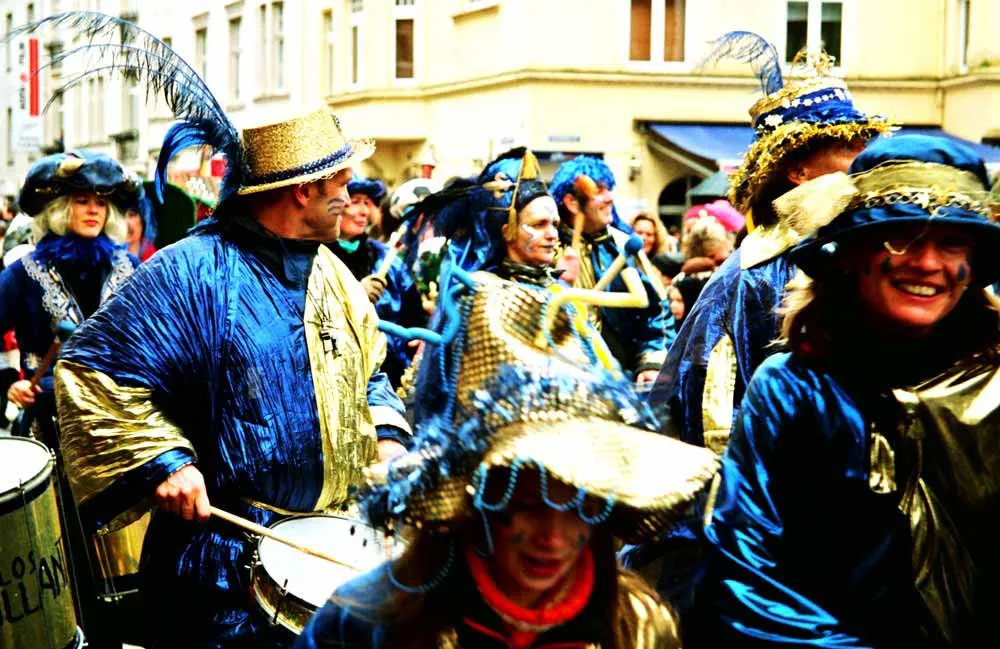
For some Germans the best time of the year is not Christmas but Karneval. For a few days before Lent whole cities fill with costumes, music and processions, and the rules of everyday life are loosened. The tradition is strongest in the Rhineland, around Cologne, Düsseldorf and Mainz.
Three names for the same thing
What the season is called depends on where you are. In the Rhineland it is Karneval. In Bavaria, Austria and the east it is Fasching. In parts of the south-west and in Mainz it is Fastnacht, or Fasnet in the Alemannic dialect of the south-west. They overlap, and many people use more than one.
The calendar
The season starts at 11:11 on 11 November, the Elfte im Elften, but the main events come in the weeks before Lent, so the date changes each year with Easter. In 2027 it falls in early February.
- Weiberfastnacht is the Thursday before the main weekend. By tradition, women “take over” the town halls, and the custom of cutting off men’s ties comes from this day.
- Rosenmontag, the Monday, is the day of the biggest parades in the Rhineland, with decorated Wagen (floats).
- Faschingsdienstag or Fastnachtsdienstag is Shrove Tuesday, the last day of the party.
- Aschermittwoch, Ash Wednesday, brings it all to an end.
What happens
People sich verkleiden (dress up) in a Kostüm, from simple clown outfits to elaborate group costumes. At the Umzug (the parade), the people on the floats throw Kamelle, sweets, to the crowd, and the crowd shouts for them. Bakers sell Berliner, jam doughnuts, which are a carnival classic as well as a New Year one.
Ich verkleide mich dieses Jahr als Pirat.
I am dressing up as a pirate this year.
Kamelle! Kamelle!
Sweets! Sweets!
The cheers
Each city has its own carnival cry. In Cologne people shout Alaaf!, while in Düsseldorf and Mainz it is Helau!, and the two cities are quite particular about which is used where. The fools or jesters are the Narren, and in the south-west the carnival groups are called Narrenzünfte.